
PWA vs Native App for Small Business: UK Guide (2026)
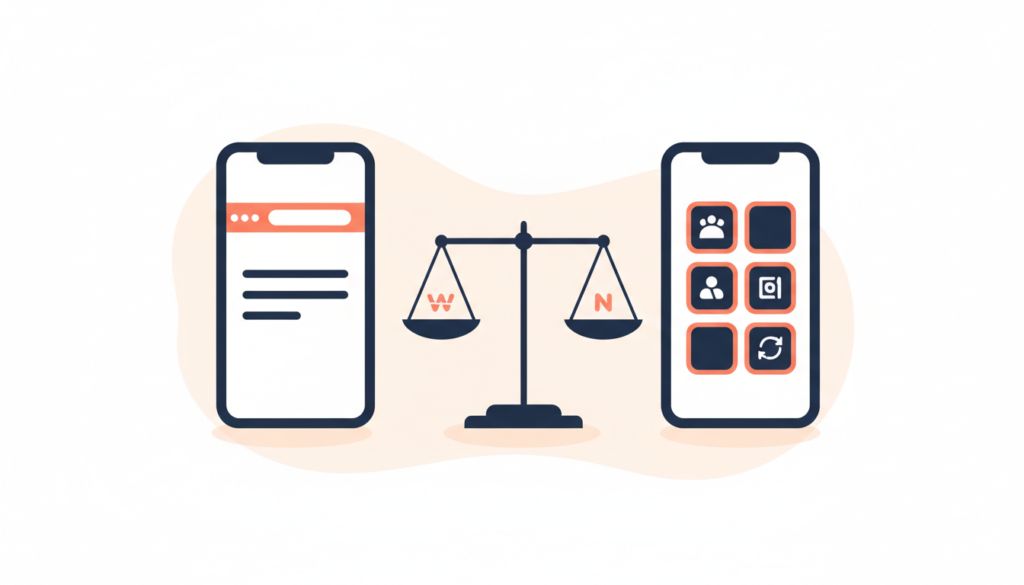
In the PWA vs native app for small business debate, a progressive web app (PWA) is usually the better first step. It fits businesses whose customers mainly book, order or check information, because one build works on every phone and costs far less. However, a native app is worth it when you need deep device features, a strong App Store presence or heavy daily use. As a typical guide, UK businesses pay around £3,000–£15,000 for a PWA and £15,000–£60,000+ for a cross-platform native app.
“Should we build an app or a PWA?” is one of the most common questions small business owners ask before investing in mobile. It comes up whether they run a salon, clinic, gym, café or local shop. The honest answer depends on how often your customers will open it and what it needs to do.
This guide explains the PWA vs native app for small business question in plain English. First, it compares costs and features in a simple table. Then it gives you a step-by-step checklist, so you can choose with confidence before you ask anyone for a quote.
In this guide
- What Is a PWA and What Is a Native App?
- PWA vs Native App for Small Business: Side-by-Side Comparison
- When a PWA Is the Right Choice
- When a Native App Is Worth the Extra Cost
- PWA vs Native App for Small Business: Typical Costs in the UK
- How to Decide: A 6-Step Checklist
- Mistakes to Avoid
- Frequently Asked Questions
What Is a PWA and What Is a Native App?
Both options put your business on your customers’ phones. The difference is how they are built, how people get them and what they can do.
Progressive web app (PWA)
A PWA is a website built to behave like an app. MDN Web Docs describes it as an app built with web technologies. Like a website, it runs on multiple platforms and devices from a single codebase. Like a platform-specific app, it can also be installed on the device and work offline.
In practice, customers open your site, tap “Add to Home Screen” and get an icon that launches full screen. There is no app store download, and every update goes live the moment you publish it.
Native app
A native app is downloaded from Apple’s App Store or Google Play. It can be written separately for each platform (Swift for iPhone, Kotlin for Android) or with a cross-platform framework such as Flutter or React Native, which shares one codebase between both.
Native apps get the fullest access to the phone, the smoothest performance and a listing in the stores, but they cost more to build, must pass store review and need regular updates.
PWA vs Native App for Small Business: Side-by-Side Comparison
Your customers are already on their phones. According to Ofcom’s Online Nation 2025 findings, UK adults now spend an average of four and a half hours online a day, most of it on a smartphone. They also use an average of 41 apps a month. So the question is not whether to be on mobile, but which format earns a place on the home screen.
| Factor | PWA | Native app (incl. cross-platform) |
|---|---|---|
| Typical build cost (UK) | £3,000–£15,000 | £15,000–£60,000+ |
| Typical timeline | 3–8 weeks | 2–6 months |
| How customers get it | Visit the site, add to home screen | Download from App Store or Google Play |
| Updates | Instant, no review | Store review for each release |
| Push notifications | Yes, with some iPhone limits | Yes, full support |
| Offline use | Basic to good | Full |
| Device features (Bluetooth, NFC, background tasks) | Limited, especially on iPhone | Full |
| Found through Google search | Yes, pages can rank like a website | Mostly through the stores |
| Store fees | None | Apple and Google developer accounts |
One point that often surprises owners: PWAs on iPhone used to have no push notifications at all. That changed with iOS and iPadOS 16.4, when WebKit added Web Push for Home Screen web apps. The catch is that the customer must first add the web app to their Home Screen before it can ask permission to send notifications.
Need help with this? AK Softs Digital builds websites, mobile apps and AI automation for small businesses in the USA, UK, UAE and Australia. Message us on WhatsApp or get a free quote in 24 hours.
When a PWA Is the Right Choice
For most local and service businesses, a PWA covers what customers actually do on their phones. It is usually the smart choice when:
- Customers book, order or enquire. Appointment booking, click-and-collect orders, quote requests and menus work very well in a PWA.
- You want to be found on Google. A PWA is still a website, so its pages can rank in search. A store-only app cannot do that.
- Budget and speed matter. One build serves iPhone, Android and desktop, so you pay for one product instead of two.
- You change content often. Prices, opening hours, offers and menus update instantly, without waiting for store approval.
- Many visitors are one-off. People who will not download an app can still use every feature in the browser.
A PWA only works as well as the website underneath it. If your current site is slow or awkward on a phone, fix that first. Our guides on building a fast-loading website and responsive design for SEO cover the basics.
When a Native App Is Worth the Extra Cost
A native app earns its higher price when the app is central to how customers use your service, not just a nice extra. Consider native when:
- Customers use it several times a week. Gym check-ins, loyalty wallets, membership passes and repeat food orders benefit from a fast, always-there app.
- You need device hardware. Bluetooth, NFC, advanced camera features, background location or health data are far easier, and sometimes only possible, in native apps.
- Reliable notifications are core. If reminders and alerts drive your revenue, native push is the most dependable on both platforms.
- An App Store listing builds trust. In some sectors, customers expect to find you in the stores.
- The app must work fully offline. Field staff tools, inspection checklists and stock apps often need this.
If native is the answer, a cross-platform framework usually keeps the cost down for small businesses. We explain the full budget picture, including maintenance, in our guide to the cost to build an app for a small business.
PWA vs Native App for Small Business: Typical Costs in the UK
The figures below are typical ranges, not fixed quotes. Agencies and freelancers price very differently, and integrations with booking, payment or stock systems can move a project up a tier.
- PWA built on an existing website: typically £3,000–£8,000 for install support, offline pages and push notifications.
- Custom PWA with logins and bookings: typically £8,000–£15,000.
- Cross-platform native app (one codebase, both stores): typically £15,000–£60,000.
- Separate native apps for iPhone and Android: often £40,000 and up, because there are two codebases to build and maintain.
Native apps also carry store costs. The Apple Developer Program is 99 USD per membership year, charged in local currency, and Google Play has a US$25 one-time registration fee. Add hosting, maintenance and updates for new iOS and Android versions each year.
How to Decide: A 6-Step Checklist
Work through these steps with your team. They take about an hour and will make any quote you receive much easier to compare.
- Write the one job the app must do. For example: “Let regular clients rebook in under 30 seconds.”
- Estimate how often customers will use it. Monthly or less points to a PWA. Several times a week makes native worth considering.
- List the phone features you truly need. If the list includes Bluetooth, NFC or background location, native is likely.
- Check your analytics. See how much traffic is mobile and how it splits between iPhone and Android.
- Map your systems. Note the booking tool, payment provider, CRM or stock system the app must connect to, as integrations often cost more than screens.
- Plan the first 12 months of costs. Include build, hosting, store fees, updates and a small budget for improvements after launch.
A practical tip: you do not have to choose forever. A common path is to launch a PWA, learn which features customers actually use, then wrap the same web app for the stores or move to a cross-platform app once demand is proven.
Mistakes to Avoid
- Building an app nobody downloads. If customers visit once a year, a fast website will serve them better.
- Ignoring iPhone limits. Test PWA features such as notifications on real iPhones, not just Android.
- Forgetting the admin side. Staff need a simple way to manage bookings, products and offers.
- Skipping automation. An AI assistant can answer common questions inside your app or PWA. See our AI chatbot cost guide for what that adds.
- Not owning your code and accounts. Make sure the source code, domain and store accounts are in your business’s name.
Key Takeaways
- For most small businesses, a PWA is the faster, lower-cost first step: typically £3,000–£15,000 in the UK.
- A native app (typically £15,000–£60,000+ cross-platform) pays off for frequent use, device hardware or a must-have store listing.
- PWAs can send push notifications on iPhone since iOS 16.4, but only after being added to the Home Screen.
- Native apps add store costs: 99 USD a year for Apple and a US$25 one-time fee for Google Play.
- Start with the job the app must do and how often customers will use it, then choose the format.
Frequently Asked Questions
Is a PWA cheaper than a native app?
Usually, yes. One PWA serves iPhone, Android and desktop, so a UK small business typically pays £3,000–£15,000, compared with £15,000–£60,000+ for a cross-platform native app. There are also no app store fees.
Can a PWA send push notifications on iPhone?
Yes, since iOS and iPadOS 16.4. The customer must add the web app to their Home Screen first, and the permission request has to follow a tap or other direct action.
Can a PWA be listed in the App Store or Google Play?
A PWA can be packaged for the stores, which is common on Google Play. Apple reviews these apps more strictly and expects real app-like value, so a simple wrapped website may be rejected. Plan extra work if a store listing matters.
Do I need an app if I already have a good website?
Not always. If customers mainly check information or book occasionally, a fast, mobile-friendly website or PWA is enough. An app makes sense when people will use it regularly or need phone features a browser cannot offer.
How long does it take to build a PWA?
Typically 3–8 weeks, depending on whether it builds on your existing website and how many features and integrations it needs. A native app usually takes 2–6 months.
Not Sure Whether You Need a PWA or an App?
AK Softs Digital designs websites, PWAs, mobile apps and AI automations for small businesses, with 175+ client reviews, a 4.9 rating and experience working with teams in the UAE and France. Tell us what your customers need to do, and we will recommend the right format and a realistic budget in a free consultation.

Anees Dilawar
Founder & CEO of AK Softs Digital. MS Computer Science, 10+ years teaching and building software, and 6+ years delivering WordPress, Flutter and AI automation projects for clients in the USA, UK, UAE and Australia.
App Development
Get a clear plan and a fixed quote in one call
Planning an app? We design and build Flutter apps for iOS and Android, from MVP to launch.